
Blogs and CorePages: Write Content That Helps Buyers Find You
Every seller answers the same few questions again and again. How do I use this? Will it suit me? How long will it last? Each answer takes a few minutes. Over a month, those minutes add up to whole days.
Now imagine writing that answer once, putting it on your store, and letting it work for you every single day. That is what blogs and CorePages are for. In this guide, we, as the OneWooz team, explain the difference between the two, what to write about, and how to write in a way buyers actually enjoy. This page is part of our guide to building your store with OneWooz.
Meet Lalitha
Lalitha blends loose leaf tea in her kitchen. Masala chai, a lemongrass green tea, and a sleepy chamomile mix her neighbours swear by.
Her buyers love her teas. However, almost every new buyer sends the same messages. "How much tea do I use for one cup?" "Should I add milk to the green tea?" "How do I keep it fresh?" She typed the same replies so often that she saved them in her phone notes.
One evening, she looked at those notes and smiled. "This is a guide," she said. "I have been writing it for a year without knowing." We will see what she did with it later on this page.

Why content helps you sell
People rarely buy the first time they see a product. First, they look around. They ask questions. They compare. When your store answers those questions clearly, three good things happen:
- Buyers trust you more. A seller who explains things well feels like an expert.
- You spend less time on repeat questions. You share a link instead of typing the same reply.
- Search engines get a reason to send people your way. Every helpful page is one more way to be found.
Google says it aims to reward helpful, reliable, people-first content. In other words, if you write to help your buyers, you are already doing the right thing.
What a blog post is
A blog post is short and timely. It is the kind of thing you might share in a post or a message to your regular buyers. On OneWooz, your blog lives right inside your store, on the same address as your products.
Good blog posts are usually:
- About one small topic, such as a care tip or a new arrival.
- Quick to read, often a few hundred words.
- Tied to a moment, like a festival, a season or a new collection.
- Personal, with a little of your own story in them.
For example, Lalitha might write "Three teas for rainy evenings" or "Why we changed our chai recipe this winter."
What a CorePage is
A CorePage is a rich guide on a topic your buyers care about most. It goes deeper than a blog post, and it stays useful for a long time. It is the kind of page a buyer bookmarks, shares with a friend and comes back to.
A good CorePage usually:
- Covers one big topic from start to finish.
- Answers the questions buyers ask before, during and after they buy.
- Uses headings, short lists and photos so it is easy to scan.
- Links to the products and posts that go with it.
In fact, the page you are reading right now is a CorePage.
Blog post or CorePage? A quick guide
Not sure which one to write? This table can help.
| Blog post | CorePage | |
|---|---|---|
| Length | Short | Longer and deeper |
| Topic | One small idea or moment | One big subject, covered fully |
| How long it stays useful | Weeks or months | Months or years |
| Best for | News, tips and stories | Guides buyers return to |
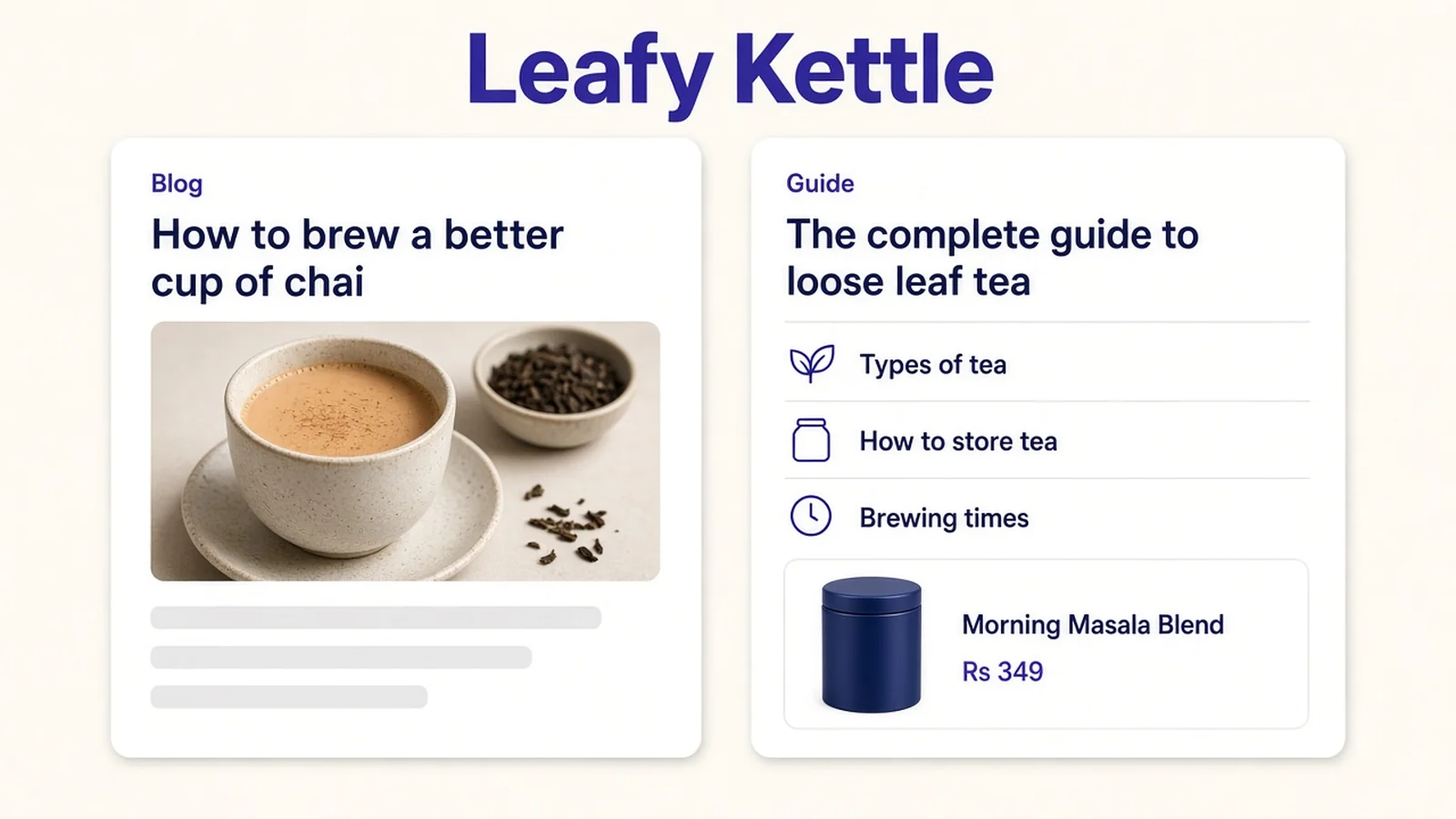
| Example for a tea seller | "Three teas for rainy evenings" | "The complete guide to loose leaf tea" |
That said, there is no wrong answer. Many sellers start with a few blog posts. Then, once they see which topics buyers love, they grow the best ones into a CorePage.
What should you write about?
The best ideas are already in your inbox. Look at the questions buyers ask you most. Each one can become a post or a guide.
Here are some starting points for different kinds of sellers:
- Care and use: "How to wash a handloom saree," "How to keep silver from turning dark."
- Choosing the right product: "Which fabric is best for summer," "How to pick a face oil for dry skin."
- Gifting: "Gift ideas for a housewarming," "What to send for a wedding."
- Behind the scenes: "How we print our cushion covers," "A day in our kitchen."
- Seasons and festivals: "Festive boxes to order early," "Summer drinks to make at home."
Moreover, keep a small list in your phone. Every time a buyer asks something new, add it. In a few weeks, you will have more ideas than time.
How to write so people keep reading
You don't need to be a writer. You just need to write the way you talk to a buyer you like. Here are a few simple habits that help:
- Answer the question early. Put the main answer near the top, then explain.
- Keep sentences short. One idea per sentence is easier to read on a phone.
- Use headings. They help buyers jump to the part they need.
- Add your own photos. A real photo of your product in use beats a stock image every time.
- Be honest. If a product is not right for something, say so. Buyers remember that.
The W3C, the group that sets many web standards, has simple tips for clear writing that make pages easier for everyone to read.
Make every page easy to find
When someone searches, they first see a short title and a line of text about your page. On OneWooz, you can let your store fill these in for you, or write them yourself. Either way, you can preview how the page may look in search before you save it.
Photos matter too. Your photos and videos live in one Media Library, so you can add the right image to any post in a few taps. Google shares helpful advice on image best practices, like clear file names and useful alt text.
If you want a simple overview of how search works, Google's SEO starter guide is written for beginners. We cover the rest of getting found, including AI search, in our Grow features.
Link your content to your products
Content works best when it leads somewhere. If your guide talks about masala chai, link to your masala chai blend. If your post is about gifting, link to your gift boxes.
However, keep it natural. A buyer reading a guide wants help first. One or two well-placed links feel helpful. Ten links feel like an advert. Our selling guide on writing product pages that sell pairs well with this, because your content and your product pages should answer the same buyer questions.
How often should you post?
There is no magic number. A steady, honest pace beats a burst of posts followed by silence. For many small sellers, one blog post a month and one new CorePage every few months is a comfortable start.
Above all, update what you already have. If a price, a recipe or a care tip changes, fix the page. Fresh, correct pages keep buyers' trust.
Your content, on your own address
Your blog and CorePages sit on your store, so every visitor they bring lands right next to your products. When your store has its own domain, every guide also helps build your name. Our guide to custom domains and SSL explains how to give your store an address buyers remember.
If you sell under more than one brand, each brand's buyers will have different questions. Our guide to running multiple stores on one account can help you decide when a second brand deserves a store of its own.
Lalitha's guide, a few months later
Let's go back to Lalitha.
She turned her phone notes into a CorePage called "The complete guide to loose leaf tea." It covers how much tea to use, how long to brew each blend and how to store it. She also writes a short blog post every month, like "Three teas for rainy evenings."
Now, when a new buyer asks how much tea to use, she sends one link. Some buyers find the guide through search before they even know her store. One of them wrote, "Your guide was so clear, I had to try your chai."
She still loves chatting with buyers. She just doesn't type the same answer ten times a day anymore.
Where this fits in OneWooz
Blogs and CorePages are one part of Build, where you set up and shape your store. To see the rest, from your storefront to your products, head back to our Build features. For the big picture, visit our OneWooz features overview.
Frequently asked questions
Does every OneWooz store come with a blog?
Yes. Every OneWooz store has a built-in blog, so your posts live on your store, right next to your products.
What is the difference between a blog post and a CorePage?
A blog post is short and timely, like a tip or a news update. A CorePage is a deeper guide on a big topic, made to stay useful for a long time.
Do I need to be a good writer to use blogs and CorePages?
No. Write the way you would explain something to a buyer. Short sentences, clear headings and your own photos go a long way.
What should my first CorePage be about?
Start with the question buyers ask you most. If you answer it often in chats, it will make a helpful guide.
Can I choose how my pages look in Google search?
Yes. You can let your store fill in the title and description for you, or write your own. You can preview how the page may look in search before you save it.
How often should I write a new post?
There is no fixed rule. A steady pace, such as one post a month, works well for many small sellers. Keeping old pages correct matters just as much.
Will content bring buyers to my store?
Helpful content gives search engines and buyers a good reason to visit. It takes time to build, and results are never guaranteed. Still, every clear answer you publish makes your store more useful.
Keep exploring
- Build features: everything you can set up in your store.
- Custom domain and SSL: give your store an address buyers trust.
- Multiple stores on one account: run more than one brand with one login.
- Grow features: get found, bring buyers back and sell through creators.
Start today
You already know the answers your buyers need. Now give them a home on your own store. Your own online store in 15 minutes, ready to receive orders with payments, shipping and your domain set up.
Have a look at our plans and pricing, or jump right in.