
The short answer
When people search "e-commerce websites in India", they usually mean one of two things. Some want a list of the big shopping sites. Others, like sellers, want to know where to sell. This page answers both.
The main e-commerce websites in India are marketplaces: Amazon.in, Flipkart, Meesho, Myntra, Nykaa, Ajio, Tata CLiQ and JioMart. If you are a seller, you can list on them. Or you can build your own e-commerce website and sell directly. The honest answer for most sellers is to do both, and to know what each one gives and takes.
Disclosure: I built OneWooz, a platform for sellers to run their own online store. So I have a view. I have sold on marketplaces myself and know them from the inside, so I will say plainly when they are the right choice. I checked every fee below on official pages on 18 November 2026 and link each one. Where a company does not publish a number, I say so.
The main e-commerce websites in India, and what they publish for sellers
| Website | Known for | What the seller page says (checked 18 Nov 2026) |
|---|---|---|
| Amazon.in | General marketplace | Referral fee starts at 0 percent and varies by category, with zero referral fees on over 12.5 crore products. Closing fee starts at ₹2. Weight handling starts at ₹37 per item. 18 percent GST is added to fees. Payment becomes due 7 days after delivery |
| Flipkart | General marketplace | 0 percent commission on products under ₹1,000 and across fashion. A fixed fee applies, set by your seller tier. Other category rates are shown only after you log in. Payment "as fast as 3 days", depending on tier |
| Meesho | Value shopping, reselling | Says 0 percent commission across categories. Shipping is charged, with 18 percent GST on it. No public per-kg rate list |
| Myntra | Fashion | No full public rate card. In January 2026 it announced zero commission for new homegrown D2C brands in its Rising Stars programme |
| Nykaa | Beauty and personal care | No public commission or logistics rate card on its seller pages |
Other sites you will see on lists include Ajio, Tata CLiQ, JioMart, FirstCry, Snapdeal and IndiaMART (mostly business-to-business). I have not compared their seller fees here, so I do not quote any. Check each seller page yourself, and be wary of blogs that quote "typical" commission percentages without a source.
What a marketplace really costs a seller
"Zero commission" is a headline. The bill has more lines. Here are the lines, using Amazon's published fee page as the example, since it is the most detailed.
| Line on the statement | What it is | Published detail |
|---|---|---|
| Referral fee (commission) | A percentage of the price | Starts at 0 percent, varies by category |
| Closing fee | A fixed amount per item | Starts at ₹2, varies by price and fulfilment. Amazon updated its closing fees from 7 September 2026 |
| Shipping or weight handling | Delivery to the buyer | Starts at ₹37 per item shipped, depends on volume and distance |
| Pick and pack | If the marketplace packs for you | ₹17 per unit for standard items up to 1 kg, then more by weight |
| Storage | If you keep stock in their warehouse | ₹50 per cubic foot per month |
| GST on fees | Added to all of the above | 18 percent |
| Ads | Sponsored placement | Optional on paper. Many sellers feel it is needed to be seen |
Flipkart and Meesho have their own versions of this. Flipkart's fixed fee depends on your tier and its full rate card is behind login. Meesho's shipping rate is shown per order in your payment file, not as a public list.
I want to be careful. I am not saying these fees are unfair. A marketplace carries real cost to bring you a buyer, move a parcel and take a payment. I am saying the headline number is not the bill, so build your own statement from the lines above before you decide.
My own experience, in my opinion only: on one platform I was asked to send stock to more warehouses before my products showed up in more states. That meant more stock sitting in boxes, more storage fees and more handling costs. Every order also carried pick-up and packaging charges on top of the platform's fee and shipping. On paper a sale looked good. By the time the money reached my account, a big piece of it was already gone.
What your own e-commerce website costs
An own-store bill has different lines:
| Line | What it is | Typical published detail |
|---|---|---|
| Platform plan | Monthly or yearly subscription | Varies a lot. See our platform comparison |
| Payment gateway | Takes UPI, card and net banking | Razorpay's standard rate: 2 percent plus 18 percent GST on the fee |
| Shipping | Courier cost | You pay the courier. An aggregator like Shiprocket lists plans from free to ₹799 a month |
| Platform transaction fee | Some platforms add one | Shopify adds 2 percent on its Basic plan for third-party gateways, as an example. Others charge nothing or a fixed amount |
| Ads | Optional | You pay only if you choose to |
The big difference: on your own store, you get the buyer in the first place only if you bring them. A marketplace brings them to you. That is why the two are not rivals. They answer different questions.
Five things that matter more than the fee
1. Who owns the customer
On a marketplace, you fulfil the order, but the relationship stays with them. Amazon's seller agreement says you may not use customer personal data, including contact information, for any purpose other than fulfilling orders or customer service (Business Solutions Agreement, section 11, last updated March 2020, so check the live terms). The buyer who loved you goes back to the marketplace next time.
On your own site, the customer list is yours. You can email, thank, and sell again.
2. Who controls visibility
On a marketplace, your listing competes in someone else's search results and, for many products, for the featured offer. Amazon says that if more than one seller offers a product, they compete for the Featured Offer (the "Buy Box"). Placement depends on performance and price.
I cannot see inside any platform's system, so this is my opinion only. I made products that became best sellers, yet in many states my products did not show up normally. They did show up when I paid for ads. To me that looked like a push to pay.
On your own site, nobody can hide you. But nobody sends you visitors either. You earn them through search, content, Google's free product listings, social media, email and, if you choose, ads.
3. Who sets the price
On a marketplace, a bigger seller can drop the price and force everyone down. I watched this loop. One seller cuts the price. Another matches it. A third pours money into ads and offers. Everyone bleeds, and they all settle at the same low price. Then a new seller with more cash arrives and it starts again. In the end, I felt only two parties were happy: the customer and the marketplace.
On your own site, your price is yours. Buyers can still compare, but you are not in a live price race on the same page.
4. Account risk
Marketplaces can pause or close accounts for performance, paperwork or policy reasons. Amazon states this plainly in its seller guidance. When I was removed from a services app in 2016, my clients still trusted me, but on that app it did not count. A store you own cannot be switched off by one rule change.
5. Speed to first order
This is where marketplaces win clearly. Flipkart says it has more than 50 crore customers. A new store has none. If you need orders this week, a marketplace is the faster route.
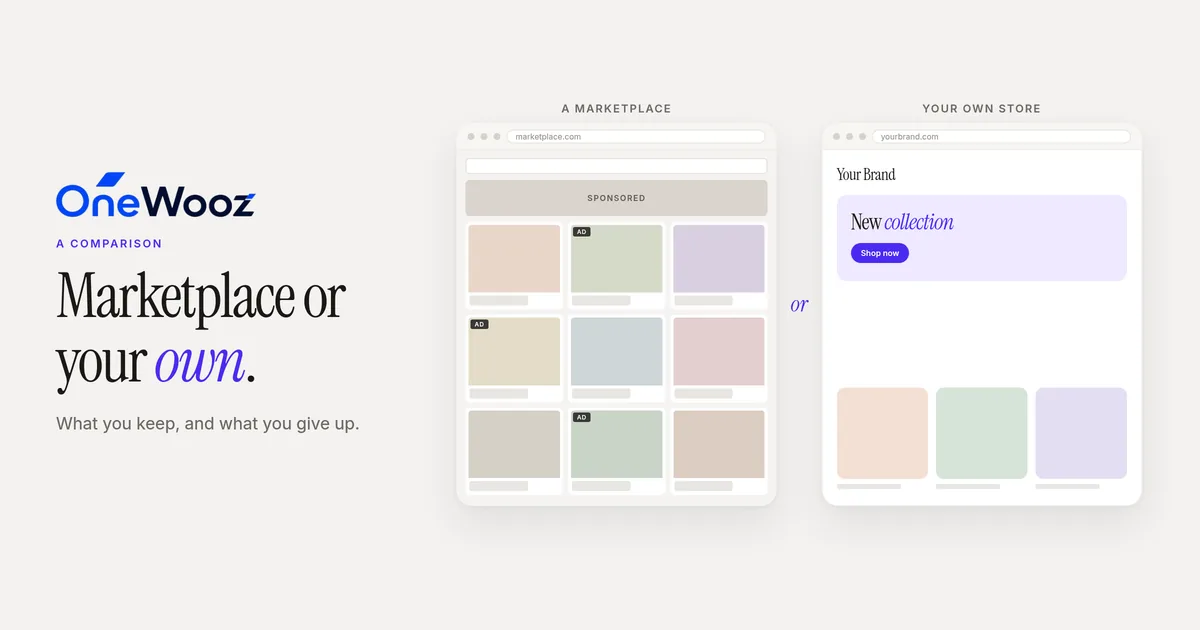
Marketplace vs own website, side by side
| Marketplace | Your own website | |
|---|---|---|
| Buyers on day one | Yes | No. You bring them |
| Customer contact details | Restricted to fulfilment and service | Yours |
| Price control | Live price comparison with other sellers | Yours |
| Brand | Your product sits next to others | Your own look and your own pages |
| Cost shape | Fees on each sale, shipping, GST on fees, often ads | Plan, gateway, shipping, optional ads |
| Rules | Set by the platform and can change | Set by you, within the law |
| Setup effort | Low | Low to medium |
| Best for | First sales, testing a product, reach | Repeat buyers, brand, long-term margin |
When a marketplace is the right choice
- You are testing a new product and want proof before you build a brand.
- You have low-priced items where reach matters more than margin.
- You need orders this week and have no audience yet.
- You sell in a category where buyers expect to find you on a big site.
I would not tell a new seller to skip marketplaces. Many of us started there, including me. The mistake is staying only there.
When your own website is the right choice
- You already have repeat buyers or an audience, and want to keep the relationship.
- Your product is branded or handmade and a listing next to cheaper copies hurts it.
- You want to price for margin, not for the lowest bidder.
- You want to be found on Google and in AI answers by your own name.
How to use both without a mess
- List your best-selling products on the marketplace for reach. Keep your brand name consistent everywhere.
- Put your full range and your story on your own store. That is where a person who searches your brand name should land.
- Check each marketplace's rules before you put anything in a parcel or message a buyer. Amazon's agreement restricts use of customer data, and other platforms have their own rules. Do not risk your account for a short cut.
- Grow the owned channel from the outside. Instagram, search, Google's free product listings, creators and email bring buyers who never saw the marketplace.
- Track margin per channel. Use the line-by-line statement above. Where the margin is better, push harder.
For a step-by-step version, see how to start an ecommerce business in India and how to create an online store.
Where OneWooz fits
OneWooz is for sellers who want the second half of that list. You get your own online store in 15 minutes, ready to receive orders, with payments, shipping and your own domain set up. Your customer data belongs to you. It is built to help your store be found in search and in AI answers, so ads are your choice and not a must. Part payment on cash on delivery is on every plan, you can show your products on Google Shopping with one click, and creators can run mini stores with your products.
Plans are ₹666 a month billed yearly, or ₹1,999 a month billed monthly. A small commerce fee applies on delivered orders. See the pricing page for the current amounts.
We are not a marketplace. We do not bring you shoppers the way a big site does. If you want that, use a marketplace as well. If you want to stop renting the shop, the customer and the traffic, that is what we are for. Read our story to see why.
Frequently asked questions
Which are the biggest e-commerce websites in India?
Amazon.in and Flipkart are the two best known general marketplaces. Meesho, Myntra, Nykaa, Ajio, Tata CLiQ and JioMart are also widely used. I do not quote market share numbers because I could not verify a reliable current ranking.
Is it better to sell on Amazon or Flipkart or on my own website?
It depends on your goal. For first orders and reach, marketplaces are faster. For repeat buyers, brand and price control, your own website is better. Most sellers do best with both.
Do Amazon and Flipkart really charge zero commission?
On many products, yes. Flipkart lists 0 percent commission on products under ₹1,000 and across fashion, and Amazon lists zero referral fees on over 12.5 crore products. Other fees still apply, such as closing or fixed fees, shipping, GST on fees, and ads if you use them.
Can I get my marketplace customers to buy from my own website?
Be careful. Amazon's agreement says you may only use customer personal data to fulfil the order or give customer service. Read each marketplace's rules before you try. A safer approach is to build your brand name outside the marketplace, so people searching for you land on your store.
How much does it cost to run my own e-commerce website in India?
It depends on the platform. You pay a plan, a payment gateway fee (2 percent plus GST on the fee at Razorpay's standard rate), and shipping. Some platforms also charge a fee on each order. We compare the main options in best ecommerce platforms in India.
Can I sell on a marketplace and my own website at the same time?
Yes, and it is what I recommend. Keep prices fair on both, keep your brand name the same, and follow each platform's rules.